


 Cart
Cart
 sales@molnova.com


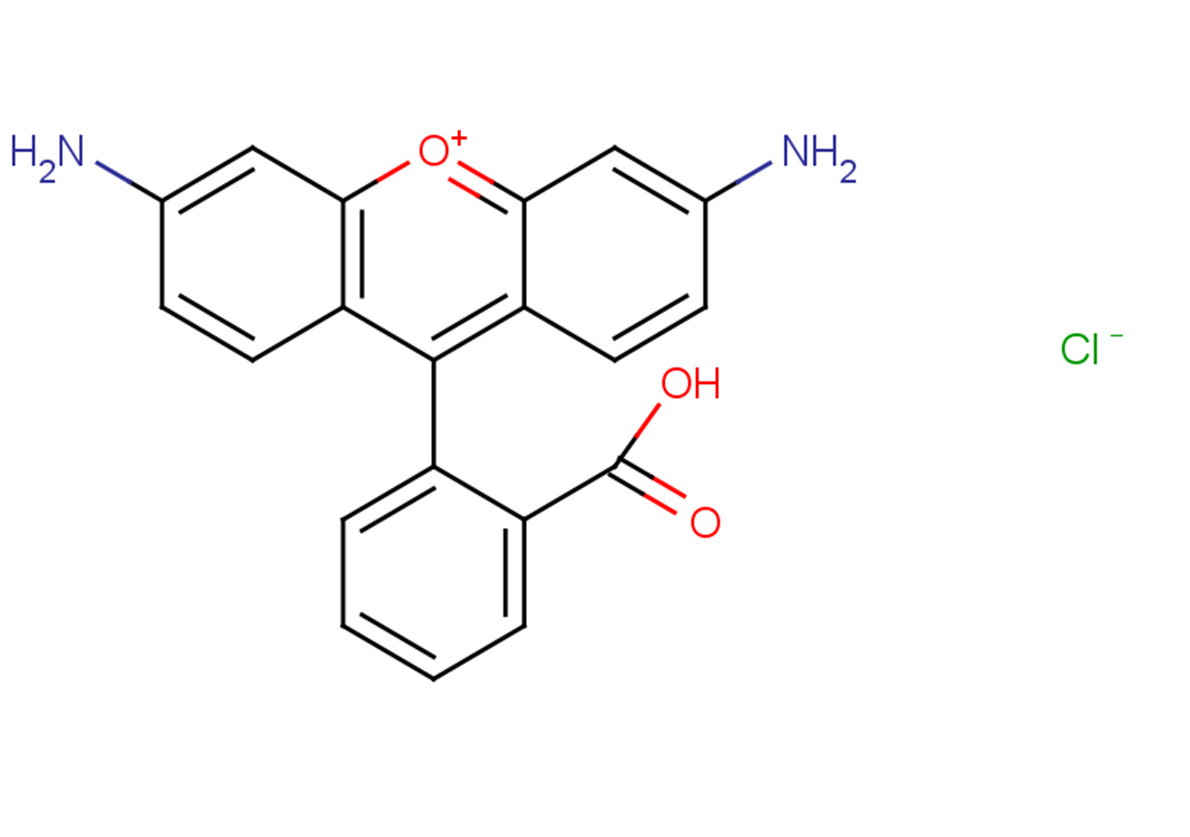
Rhodamine 110
CAS No. 13558-31-1
Rhodamine 110( Rhodamine 110 chloride | RH110 )
Catalog No. M23515 CAS No. 13558-31-1
Rhodamine 110 is a xanthene dye similar to fluorescein and eosin.
Purity : >98% (HPLC)
 COA
Datasheet
HNMR
HPLC
MSDS
Handing Instructions
COA
Datasheet
HNMR
HPLC
MSDS
Handing Instructions
| Size | Price / USD | Stock | Quantity |
| 50MG | 38 | In Stock |


|
| 100MG | Get Quote | In Stock |
|
| 200MG | Get Quote | In Stock |
|
| 500MG | Get Quote | In Stock |
|
| 1G | Get Quote | In Stock |
|
Biological Information
-
Product NameRhodamine 110
-
NoteResearch use only, not for human use.
-
Brief DescriptionRhodamine 110 is a xanthene dye similar to fluorescein and eosin.
-
DescriptionRhodamine 110 is a xanthene dye similar to fluorescein and eosin.
-
In VitroRhodamine 110 accumulates in mitochondria in a cationic form, which alters the pH in this cellular compartment. Rhodamine 110 accumulates in human lymphoblastoid cells and Friend leukemia cells. No cytotoxicity to human lymphoblastoid cells is observed below 10 μM, but Rhodamine 110 causes Friend leukemia cells to die at a concentrations above 100 μM.
-
In VivoRhodamine 110 is less toxic than the parent molecule based on the intravenous LD50 acute toxicity values of 89.5 mg/kg and 140.0 mg/kg for Rhodamine B and Rhodamine 110, respectively. Both molecules induce liver and kidney enlargement after ingestion, and male rats show more significant increases than female rats after Rhodamine 110 exposure. In addition, testis weight increased in male rats dosed with Rhodamine 110. The pharmacokinetics of Rhodamine 110 are assessed following oral administration at two dosages (3 and 10 mg/kg) and intravenous administration at one dosage (3 mg/kg). Pharmacokinetic parameters are calculated using an extravascular input and IV-bolus input, noncompartmental model analysis conducted with WinNonlin Standard Edition. The pharmacokinetic parameters of Rhodamine 110 indicates that the maximum plasma concentrations (Cmax) of the two oral dosages are 283.4 and 657.0 ng/mL, which are reached at 140 and 210 min, respectively. This indicates that Rhodamine 110 absorption is not rapid after ingestion, as it took over 2 h to be absorbed from the intestines into the blood. The areas under the concentration–time curves (AUCs) for the two dosages are 138.1±20.3 and 444.0±170.8 h ng/mL. The pharmacokinetic data demonstrate that the AUC is proportional to the administered oral dose of Rhodamine 110 (3 mg/kg and 10 mg/kg). Furthermore, the clearance (Cl) of the two orally administered doses is 7.94 and 8.61 mL/min/kg, respectively.
-
SynonymsRhodamine 110 chloride | RH110
-
PathwayOthers
-
TargetOther Targets
-
Recptorothers
-
Research Area——
-
Indication——
Chemical Information
-
CAS Number13558-31-1
-
Formula Weight366.8
-
Molecular FormulaC20H15ClN2O3
-
Purity>98% (HPLC)
-
SolubilityDMSO:25 mg/mL (68.16 mM; Need ultrasonic and warming)
-
SMILESO=C(C1=CC=CC=C1C2=C3C=CC(N)=CC3=[O+]C4=C2C=CC(N)=C4)O.[Cl-]
-
Chemical Name——
Shipping & Storage Information
-
Storage(-20℃)
-
ShippingWith Ice Pack
-
Stability≥ 2 years
Reference
1.Jiang SH, et al. Pharmacokinetics of Rhodamine 110 and Its Organ Distribution in Rats. J Agric Food Chem. 2017 Sep 6;65(35):7797-7804.
molnova catalog



related products
-
Sultiame
Sultiame is an inhibitor of carbonic anhydrase. Sultiame can be used in antiepileptic research.
-
Uperolein
Uperolein
-
5-Hydroxy-4a,8-dimet...
The herbs of Inula hupehensis.
